
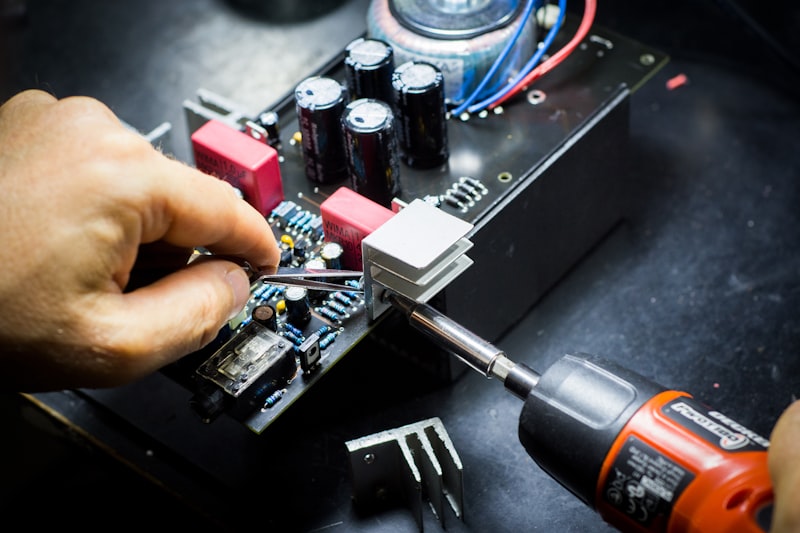
When I first started working with embedded systems, I was a web developer. I thought programming was programming. Then I tried to blink an LED on a microcontroller and spent three hours figuring out why it was not working. The answer was a single register bit I had not set.
Embedded programming is a different world. Here is what you need to know to get started.
What is an embedded system?
An embedded system is a computer built into a device to do one specific job. Your washing machine has a small computer that controls the motor, reads the temperature sensor, and manages the wash cycle. That is an embedded system.
Other examples: the engine control unit in your car, the processor in a pacemaker, the chip in a smart thermostat, industrial sensors on a factory floor. They are everywhere.
How it is different from regular programming
When you write a web app, you have gigabytes of RAM, a multi-core processor running at several gigahertz, an operating system managing everything, and libraries for almost anything you need.
Embedded systems often have kilobytes of RAM (not gigabytes — kilobytes), a processor running at a few megahertz, no operating system, and you write drivers for the hardware yourself.
You also have real-time requirements. If a sensor reading needs to be processed within 1 millisecond, it must happen within 1 millisecond. Missing that deadline can mean a machine malfunctions or a patient is harmed.
And your code needs to run for years without crashing. There is no IT department to restart the server.
The language of embedded systems
C is the dominant language. It gives you direct access to hardware, predictable performance, and runs on almost every microcontroller ever made. Most embedded developers spend their careers writing C.
C++ is used when you want object-oriented features but still need low-level control. It is common in more complex embedded projects.
Assembly is used for the most performance-critical code — interrupt handlers, startup code, tight loops where every clock cycle matters.
MicroPython and CircuitPython are popular for learning and rapid prototyping on boards like Raspberry Pi Pico. They are not used in production embedded systems.
The development workflow
You write code on your PC. You compile it with a cross-compiler — a compiler that runs on your PC but generates code for the target processor (which might be an ARM Cortex-M, not an x86). You flash the compiled binary to the microcontroller using a programmer. Then you test on real hardware.
Debugging is harder than web development. You cannot just open the browser console. You use hardware debuggers (JTAG, SWD), serial output, or oscilloscopes.
Where to start
Get an Arduino Uno or a STM32 Nucleo board. Write a program that blinks an LED. Then read a button. Then read a temperature sensor. Then display something on a small screen.
Each step teaches you something new about how hardware and software interact. It is challenging, but there is something deeply satisfying about writing code that controls a physical object in the real world.